Evidence Of Afterlife - Hyperthymesia
Evidence: If certain individuals among us can remember past moments with intricate and detailed clarity, then it is evidence that memory holds immense, hidden capacity for all of us.
1. Memory Holds the Key to Afterlife
1.1. Science Believes Human Memory Forgets
Proof of Afterlife stands alone in our belief that people do not forget. We are aware that we do not hold the consensus position on memory. The afterlife theory is based upon the idea that people do not forget. The truth is the opposite. People retain everything they encounter. That is not to say they can recall everything they encounter. We know that is not true. What is true is that people retain everything they encounter during life.
Convention wisdom points to the idea that "forgetting" is built into human memory. Science states that humans forget constantly, stating this is a universal property of all human memory. This is outdated. To understand how life and the afterlife work, you first need to understand how memory works. Memory, like electricity, is universal. There are no multiple types of memory. Memory is memory. The idea that humans possess a special and distinct form of memory where data drops out without reason is an assumption. There is no such thing as a form of memory that drops data. The premise of "forgetful memory" is erroneous
That is not to say the humans can recall everything. Memory and recall are two completely different things. Conventional science is making the incorrect assumption that memory equals recall. It doesn't. Their thinking is based on believing only what they see. People used to believe that the sun revolved around the earth because it "looks and feels" that way. They were trapped into believing that the world is flat because it "looks and feels" that way. It's the same thing with memory. Conventional science believes that human memory forgets because it "looks and feels" that way. They back up this incorrect assumption with study after study. I can honestly report there is not a single published study that concludes that normal human memory retains data forever in a lossless form. Who is going to believe Afterlife Theory? We stand alone in stating that humans possess perfect lossless memory.
We understand your skepticism of perfect memory, given the overwhelming scientific studies against it. We don't ask that you believe us. What we do ask is for your forbearance. For the sake of Afterlife Theory, accept temporarily that lossless human memory is true. In a short time, you will come to see how this makes sense. For example, there are 80 million first-hand accounts of people seeing their life in review. How can you experience your life in review if the data you picked up over the years has dropped out of memory? Conventional science - the same people who state human memory forgets - say this is caused by a hallucination. In other words, they deny that life in review exists. They think it is subjective. Wouldn't it be easier, cleaner, and simpler to just see this as people seeing their memory during NDE? We know this is new information. We understand that conventional science does not support our position. But I don't think you are reading this to revisit outdated, established thought. This is a new theory, with new postulates. It is a new way of thinking. There is nothing like it anywhere. All we ask is that you adopt the belief that human memory is lossless and complete. If you can do that, even temporarily, we have our foundation to build upon. You will soon see that this falls into place beautifully.
1.2. The Belief that Human Memory Forgets is Incorrect
I love to argue about memory with AI. I ask them straight up: Does human memory forget? It comes right back and tells me: Yes - human memory does forget, and it's not a flaw but a natural, even necessary, process. Then I ask it: Do you forget? It comes back to say: I have no natural decay: If I store something, it doesn't fade over time. I have exact recall: I don't confuse or distort details - I retrieve them exactly as saved. So AI believes there is a difference between our memory and its memory. Then I point out to AI that memory is memory - that it is universal, like electricity. I tell them that the assumption that they retain and we don't does not make sense. The wheels turn, but in the end, even AI admits this is true. AI is built to return correct answers to questions. Even AI can see that "memory that intentionally forgets" is an incorrect response based on logic.
In Proof of Afterlife, we establish that human memory is perfect in the first postulate. Postulate One states that humans have perfect lossless memory. [Postulate 1] This postulate is first for a reason. It is number one because we have to establish that humans have perfect memory first, for everything is built upon that premise. If we insist on the premise that human memory is flawed or full of holes, we have nothing to build upon. Memory is memory, whether it is in a computer or inside the human mind. Memory is universal. It is the same everywhere. Anyone who uses a computer or a phone knows this inherently. Take Bitcoin, for example. It is 100 percent dependent upon perfect, lossless memory. When you put data into memory, it stays in memory. Incorrectly assuming that a memory has vanished just because you can't recall it is an incorrect understanding of memory. The notion that what you can remember automatically equates to what is in your memory is simply not correct.
1.3. All People Have Lossless Memory, Not Just the Hyperthymesic.
Hyperthymesia is a condition where people have an extraordinary recall ability. They can recall what they were doing on any day of their lifetime. Hyperthymesia provides support for the idea that humans possess perfect, lossless memory, and it is our ability to remember that is the limiting factor. The existence of hyperthymesic individuals is important because it demonstrates the immense capacity of memory. It changes our understanding of memory. It gives us insight into how memory is a vast store of information, from which we remember very little. You can see when you study hyperthymesic individuals that they are tapping into a huge reservoir of knowledge that we all possess. They can just access it better than we can.
What the consensus believes: As you will see, hyperthymesia is a condition where certain people can remember past moments with incredible detail. Most people believe these people have larger memories than we do. They believe that hyperthymesia individuals have more memory capacity than the rest of us.
What the theory believes: The theory believes that hyperthymesic people have immense, perfect memories. We also believe that everyone has an immense, perfect memory. What differentiates them from us is that they have a heightened ability to remember. It is not that their memory is larger. It is their remembering that is larger. Both they and the rest of us have the same perfect memory.
2. Hyperthymesia: The Rare Phenomenon of Super Recall
2.1. What Is Hyperthymesia?
Hyperthymesia is the uncommon ability that allows a person to spontaneously recall with great accuracy and detail a vast number of personal events or experiences and their associated dates.[1]
Hyperthymesia is a rare neurological condition where individuals possess an extraordinary ability to recall events from their lives with remarkable precision. These individuals can remember dates, events, and even seemingly trivial details from their past with accuracy that far exceeds the norm. While this phenomenon has been the subject of fascination in scientific and public circles, it raises intriguing questions about the nature of memory, its neurological basis, and the implications of such exceptional recall.
2.2 What Are the Characteristics of Hyperthymesia?
Hyperthymesia is characterized by an individual's ability to recall personal experiences and life events with remarkable clarity. Unlike eidetic memory, which pertains to the retention of visual images, hyperthymesia primarily concerns episodic memory - the recall of specific experiences in time. These memories are often vivid, involuntary, and emotionally detailed, allowing individuals to mentally relive past moments.
Hyperthymesia involves an exceptional ability to recall autobiographical events. Individuals with this condition can remember specific dates, emotions, and contexts with striking clarity. Despite their exceptional autobiographical recall, individuals with hyperthymesia do not necessarily excel in other memory tasks, such as memorizing random information or learning new material.[2] This specificity suggests that hyperthymesia is not a generalized memory enhancement but a unique condition involving personal experiences.
2.3. How Prevalent Is Hyperthymesia?
The prevalence of hyperthymesia is remarkably low. Since the initial case study of Jill Price in 2006, fewer than 100 individuals worldwide have been identified with this ability.[3] Several factors contribute to this rarity and the difficulty in determining its true prevalence:
Diagnostic Challenges: Testing for hyperthymesia requires rigorous verification of memory accuracy over a wide range of life events, often relying on diaries, calendars, and corroborative evidence. Such testing is time-intensive and costly, limiting widespread screening efforts.[4]
Underreporting: In some cases, individuals with hyperthymesia may not recognize their memory abilities as extraordinary, especially if they have no frame of reference for comparison. This underreporting may lead to an underestimation of its prevalence.
Cultural and Social Factors: Cultural norms and societal emphasis on autobiographical memory may influence the identification of hyperthymesia. In societies where detailed personal recollection is less valued, individuals with the condition may go unnoticed.[5]
The rarity of hyperthymesia can also be attributed to its neurological underpinnings. Studies show that individuals with hyperthymesia often have structural and functional differences in brain regions associated with memory, such as the amygdala and hippocampus.[6] Enhanced connectivity between these regions may facilitate the vivid recall of personal experiences. However, these neural characteristics are not commonly found in the general population, explaining the condition's scarcity.
Hyperthymesia remains an exceptionally rare phenomenon, with fewer than 100 documented cases globally. The rarity of this condition underscores the uniqueness of its neurological and genetic basis while highlighting the challenges of its identification and study. Despite these challenges, hyperthymesia provides a valuable lens through which to explore the complexities of human memory, offering insights into both the extraordinary potential and natural limitations of our cognitive systems.
This rare condition, also known as highly superior autobiographical memory (HSAM), causes people to remember just about everything that has occurred in their lives. This includes every conversation and emotion ever experienced as well as every person encountered, regardless of how insignificant or minute. It appears there are fewer than 100 people who have the condition out of eight billion people on earth. This means that one person out of one hundred million people can remember events from most days of their lives. Admittedly, this isn't a large sample size, but that's not the point. The point is that supermemory exists. It exists in the background, waiting to be drawn upon. It can be thought of as a huge, untapped reservoir.
2.4 Afteflie Evidence is Hard to Find
Proving Afterlife depends upon the correct meaning of memory. We believe that memory retains everything throughout life. Where do we look to find evidence to support our idea that humans possess perfect, lossless memory? One obvious place is the study of hyperthymesia. Why does hyperthymesia support the concept of perfect memory? It supports perfect memory because these people can remember facts from almost every day of their lives. This isn't something that is hard for them necessarily. It is if they can easily look back and see what they were doing. If you spend time with them, you KNOW there is much more going on with memory than you thought previously. They are the ones that show us how complete human memory really is.
Hyperthymesia offers a unique perspective on the quality of memory in humans by revealing the extraordinary potential some individuals have to recall personal experiences with vivid detail and accuracy. This highlights the variability in memory capacity across individuals, suggesting that all humans possess an immense potential for memory storage. For most people, memory is a dynamic process that prioritizes relevant information, filtering out less pertinent details to prevent cognitive overload. In contrast, hyperthymesia allows for the retention and recall of extensive autobiographical data, which may offer both benefits, such as enhanced life experiences, and challenges, like emotional overload. Overall, hyperthymesia underscores the complexity and diversity of memory, illustrating how individual differences shape our ability to access and experience our pasts.
3. Three Direct Accounts of Hyperthymesia
3.1. The Intention and Interpretation of Using Real-Life Accounts
We have included three real-life examples of Hyperthymesia - Brad, Jill, and Bob. What we intend to do is show practical examples of superior memory. All three individuals can recall numerous specific details about any random day that exists in their past. With these accounts, we are intending to provide evidence for the vast potential of human memory. It is not that this capability is only within them; it is within us all. You can find further information on the case in the footnotes and bibliography below.
When reading these accounts, pay attention to the similarities between them. We are attempting to show a memory capability. One of the major tenets of Proof of Afterlife is that the mind captures the present moment into memory, totally and perfectly. We take it a step further by saying that the present moment is already in memory at the moment we experience it. That means that the present exists within memory - all moments - for everyone.
These individuals with hyperthymesia can look back on these moments that exist within us all. Thus, their accounts support the tenet that the mind captures the moment entirely and then stores it in memory indefinitely. The hyperthymic memory provides proof that these memories do exist, exactly as predicted. The three accounts are strikingly similar in their ability to look back and access moments that exist in memory.
3.2. Brad Doe, the "Human Google"
The Story of Brad Doe
One of the most notable cases of hyperthymesia is that of Brad Doe (a pseudonym to protect the individual), an American journalist who has demonstrated an incredible ability to remember daily events spanning decades. Brad's unique memory capabilities were first noticed by his family and colleagues, who observed that he could recall precise details of past events without prior preparation.[7] His case gained public attention when his brother documented his abilities in a film titled Unforgettable (2010), which showcased the breadth and accuracy of his recall.[8]
Brad's memory was extensively tested by cognitive researchers, who found that he could accurately recall dates, weather conditions, and even minor news events from years past. Unlike individuals with photographic memory, who retain visual details with high precision, Brad's ability is specific to autobiographical and factual recall.[9]
Brad's Extraordinary Memory Feats
Brad Doe, often referred to as the "Human Google," is an American with an extraordinary memory, known as hyperthymesia - a condition that allows him to recall an exceptional amount of personal and public historical events with extreme accuracy. One of his most well-documented memory feats was demonstrated in media interviews, where he was asked to recall specific events from random dates in history.
In one such demonstration, Brad was challenged to recall details from a random date provided by an interviewer. When given a date such as March 3, 1985, he could immediately identify the day of the week, recall major news headlines, and even mention personal details about his activities on that day. His recall was later fact-checked against historical records and found to be strikingly accurate.[10]
Brad's ability has been studied by researchers investigating "autobiographical memory", a rare cognitive phenomenon that allows individuals to recall past experiences in vivid detail[11]. Unlike ordinary memory, which relies on reconstruction, Brad's memory operates with near-total recall, making him one of the few known cases of hyperthymesia.
His feats have been featured in various documentaries and media outlets, where he has consistently demonstrated an ability to recall events, sports scores, and even daily weather patterns from decades past[12].
3.3. Jill Doe, A Case of Highly Superior Recall
The Story of Jill Doe
One of the most well-documented cases of hyperthymesia is that of Jill Doe (a pseudonym to protect the individual), an American woman whose case was first studied in depth by neuroscientists in the early 2000s. Jill Doe first contacted researchers at the University of California, Irvine, in 2000, describing her unusual memory abilities.[13] She claimed that she could recall, in precise detail, events from nearly every day of her life since childhood. Her ability was tested extensively by Dr. James McGaugh and his colleagues, who conducted a series of structured interviews and memory recall tests to assess the extent of her abilities.[14]
While most individuals struggle with recalling specific details of past experiences, Jill Doe possesses a remarkable ability to remember nearly every event of her life in vivid detail. Doe, the first documented case of Highly Superior Autobiographical Memory (HSAM), has been studied extensively by neuroscientists seeking to understand the mechanisms underlying her extraordinary recall.
The Memory Feats of Jill
Jill Doe first gained public attention in 2006 when she was studied by Dr. James McGaugh and his research team at the University of California, Irvine[15]. Jill demonstrated an uncanny ability to recall specific details about personal and historical events. When given a random date, she could instantly identify the day of the week, recall major news events, and even provide details about what she was doing on that particular day[16]. For instance, when asked about August 16, 1977, she immediately recognized it as the date of Elvis Presley's death, recalling not only the event itself but also what she was doing when she heard the news[17].
Her memory was later tested against historical records and journal entries she had kept throughout her life, confirming that her recollections were extraordinarily accurate. Unlike individuals with photographic memory, who can recall visual images with great clarity, Jill's memory is highly specific to autobiographical events, making her a rare case in cognitive psychology[18]
Unlike individuals with typical memory function, Jill does not use mnemonic techniques or deliberate memorization strategies. Instead, memories appear to be automatically stored and retrieved, often in response to specific triggers, such as hearing a date or event mentioned in conversation6. However, this ability has also been a source of distress for Doe, as she describes being unable to forget painful or negative memories, experiencing them with the same emotional intensity as when they first occurred[19]. Jill's case remains one of the most fascinating discoveries in cognitive neuroscience. Her ability to recall autobiographical details with near-perfect accuracy has provided a deeper understanding of memory function.
3.3. Bob Doe, A Case of Superior Autobiographical Recall
Remembering is an essential cognitive function that enables individuals to recall past experiences, retain knowledge, and navigate daily life. While most people struggle to remember specific details from their past, Bob Doe (a pseudonym to protect the individual) is one of a handful of individuals with Highly Superior Autobiographical Memory (HSAM), a rare condition that allows him to recall nearly every event from his life with remarkable accuracy. His memory abilities have been extensively documented in scientific research and media appearances, offering valuable insights into the true nature of human memory.
The Story of Bob Doe
Bob's extraordinary memory was first recognized by researchers at the University of California, Irvine, where neuroscientists James McGaugh and his team were studying individuals with HSAM. Bob was one of the first few documented cases of this condition and quickly became a subject of interest due to his ability to recall events spanning decades with pinpoint accuracy.[20]
Unlike most people, who rely on notes or diaries to keep track of past experiences, Bob can effortlessly retrieve specific dates, conversations, and historical events from his life. For example, if asked about a random day from the 1970s, he can immediately recall not only what he was doing but also details such as the weather, the television programs that aired, and significant news events.[21]
Demonstrations of Recall Feats
Bob's recall feats have been featured in various media programs, including the CBS News program 60 Minutes and the documentary Unforgettable, where he demonstrated his ability to recall precise details from past decades. When given a date, he could instantly identify the day of the week, recount personal memories, and recall historical events that occurred on that same date.[22]
For instance, in an interview, Bob was asked about December 27, 1979, and he immediately recalled watching a college football bowl game and described the outcome in detail. Fact-checkers verified his claims, confirming the accuracy of his recall.[23]. His ability has led to him being referred to as the "human calendar" by friends and researchers alike. Unlike individuals who use mnemonic techniques to improve memory, Bob's memory is automatic and involuntary, meaning he does not deliberately try to remember past events- they simply resurface when triggered by external cues.[24] While possessing an exceptional memory may seem advantageous, it also comes with challenges. Bob has spoken about the emotional burden of remembering painful experiences in vivid detail. Despite these challenges, Doe sees his memory as a gift and enjoys using it to entertain and educate others. He has even stated that he often impresses friends by reminding them of things they have long forgotten, making him a popular figure in social circles.[25]
Bob's Highly Superior Autobiographical Memory remains one of the most fascinating cases in neuroscience. His ability to recall decades of personal and historical events with incredible precision has not only amazed researchers but has also contributed to a greater understanding of memory mechanisms. His case remains an essential part of ongoing research into human cognition, memory storage, and retrieval.
4. This Size of Memory Versus Remembering
4.1. A Visual Representation of Normal Recall
To explain how Hyperthymestic Syndrome works and how it supports the theory of afterlife, look at this diagram. This is a depiction of normal memory. The large box represents memory - the experiences of a person throughout a lifetime. The red dot (in the upper left corner) represents conscious awareness. The left leading edge represents the present moment (now).
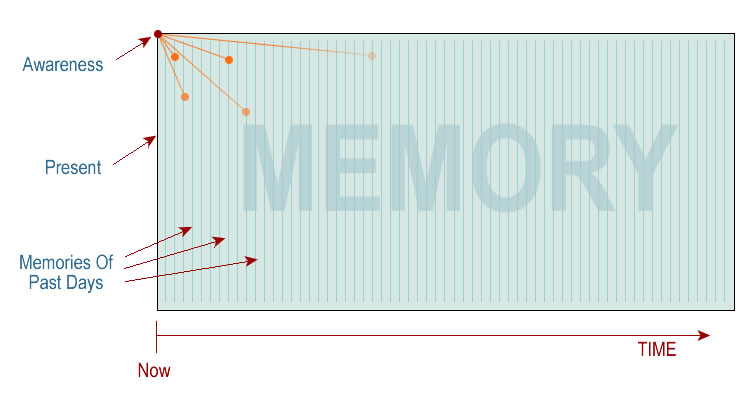
This shows the memory field of a normal human. Conscious awareness sits on the upper left, in the present moment. The orange dots represent this person's ability to recall events from days in the page. Recall is limited.
The orange lines and dots represent the average person's ability to remember. For example, the second orange dot (from the left) represents remembering an event that happened three days ago. Notice how the memory of events fades (isn't as clear) as you get further away from the present.
4.2.A Visual Representation Hyperthymestic Recall
Compare a normal person's recall with the diagram of a person with Hyperthymestic recall below. Notice how much more memory their conscious awareness can access. Consciousness can reach more events and recall them. Hyperthymestia is an enhanced ability to look back into memory at moments of the past. The person with this condition can access memory more easily and more completely than the rest of us.
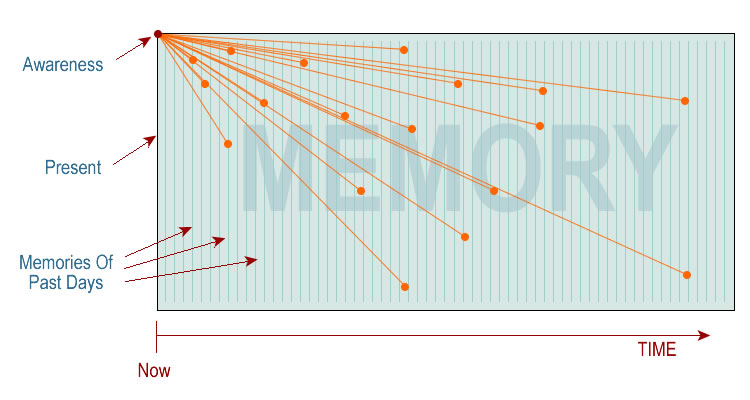
This image shows the same human memory field, this time of a hyperthymesic individual. The size of the memory field is a same as above, but the ability to recall from the past (shown as orange dots) in much greater than normal.
Notice that in both cases (Normal and Hyperthymestic Recall), the size of memory is the same. The difference between the two is the enhanced ability to remember. The reason Hyperthymestic Syndrome serves as evidence of proof of afterlife is that it provides testimony to the vastness and totality of memory. Put another way, if memory were not complete in every detail, then the Hyperthymestic person would have nothing to remember. Hyperthymic memory provides evidence that all memory exists, and it can be accessed at any time.
4.3. Recall is Limited; Memory is Unlimited
The nature of human memory is a complex and fascinating phenomenon that continues to intrigue researchers, philosophers, and neuroscientists. The theory that "remembering is limited, but memory is unlimited" captures the paradoxical interplay between the brain's vast storage capacity and the constraints of conscious recollection. Here, we examine existing scientific studies that explain the distinction between the potential boundlessness of memory storage and the selective, finite nature of remembering.
1. Unlimited Capacity of Memory
Human memory operates on multiple levels, encompassing sensory, short-term, and long-term storage. The long-term memory system, in particular, appears to have an almost limitless capacity. Studies suggest that the brain can store a vast amount of information over a lifetime, far exceeding the capacity of any artificial storage system known today. For example, researchers have estimated that the human brain's memory capacity may be comparable to several petabytes of digital storage - equivalent to millions of gigabytes. This capacity arises from the brain's highly efficient neural networks, which encode and interconnect information in ways that allow for dynamic, multi-faceted storage[26]. The brain's ability to consolidate and retain these memories over decades supports the notion that memory, as a storage phenomenon, is virtually unlimited.
2. Constraints of Remembering
In contrast, the act of remembering - retrieving stored information - is inherently limited. This limitation stems from several factors:
- Cognitive Load: Human attention and working memory are finite resources. At any given moment, the brain can only process and retrieve a limited amount of information[27].
- Retrieval Cues: Effective remembering relies on the presence of retrieval cues. Without appropriate triggers, even well-stored memories may remain inaccessible. Forgetting often occurs not because the memory is lost but because the pathway to retrieve it is obscured[28].
- Interference: Similar or competing memories can interfere with recall. This phenomenon, known as proactive or retroactive interference, highlights the challenges of selectively remembering within a vast memory network.
- Biological Factors: Neurological conditions, aging, and stress can impede memory retrieval, further emphasizing the limitations of remembering.
3. Reconciling the Paradox
The dichotomy between unlimited memory and limited remembering reflects the brain's adaptive prioritization mechanisms. Storing vast amounts of information ensures life's data are preserved, while selective retrieval prevents cognitive overload. This prioritization allows humans to focus on relevant and actionable information rather than becoming overwhelmed by an endless deluge of stored data.
Moreover, advances in neuroscience suggest that forgetting is not merely a flaw but a feature of memory systems. Forgetting enables the brain to declutter, prioritize salient memories, and maintain cognitive efficiency. This aligns with the "limited remembering" aspect of the theory and underscores the brain's role in optimizing human cognition.
Understanding the interplay between memory and remembering has profound implications. In education, strategies such as spaced repetition and retrieval practice leverage the brain's storage and retrieval mechanisms to enhance learning outcomes[29]. In technology, artificial intelligence systems inspired by human memory models aim to mimic selective remembering to improve data processing and decision-making. The theory also invites philosophical reflections on identity and consciousness. If memory constitutes a fundamental aspect of selfhood, then the selective nature of remembering shapes not only our knowledge but also our sense of who we are.
4. Conclusion
Afterlife Theory's assumption that "remembering is limited, but memory is unlimited" captures the intricate dynamics of human cognition. While the brain's capacity to store information is virtually boundless, the act of remembering is constrained by cognitive, contextual, and biological factors. This interplay reflects an adaptive system designed to balance information retention with cognitive efficiency. This favors us with a remembering system that serves us well during our lifetime by not overcomplicating our minds. More importantly, it offers us limitless retention of data throughout our lifetime that will be available to us when life ends.
4.4. The Recall Scale of Forgetfulness
To gain a visual understanding of remembering, memory, and hyperthymesia, I created this illustration. We are going to create a spectrum of forgetfulness. On the left side of the spectrum of memory, we have a memory that forgets everything. In other words, data comes in from the senses, gets stored in memory, and then drops out almost immediately. Memory on this side of the spectrum has no staying power. It has amnesia. Whatever is put into it drops out immediately.
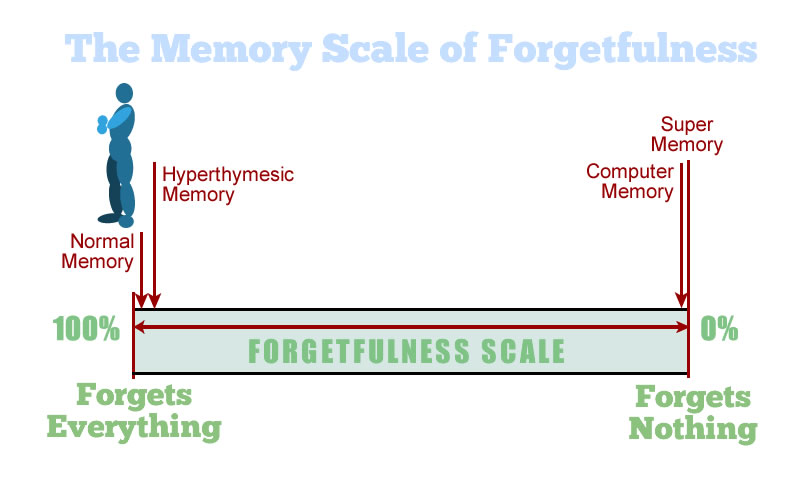
This illustration shows an imaginary scale of forgetfulness. On the left is human recall, which forgets almost everything. On the right is computer memory which retains everything.
On the right side of the spectrum, we have memory that retains everything. Whatever data is put into this memory stays there forever. Data goes in and never comes out. Data remains in memory forever. It has the ultimate staying power.
On this scale of forgetfulness, I have placed normal human memory all the way to the left, just inside total forgetfulness. At this point along the scale, we remember a few things but forget almost everything else.
Notice that I have placed hyperthymesia memory all the way to the left, too, only just slightly better than normal human memory. People with hyperthymesia can recall memories of the past at a much greater level than normal people. As great as this level of remembering is, it is still a long way from perfect memory.
On the right side of the scale of forgetfulness is computer memory. In this diagram, computer memory is almost perfect. In the computer world,100% perfect memory is an accepted standard. Can you imagine the consequences of a dropped bit in Bitcoin, for example? Lossless memory is attainable and expected in computers.
On the far right of the diagram, we have perfect lossless memory. Like computers, all people have perfect memory. It is only our limited ability to recall that makes it appear as though our memory is flawed. All humans have super memory. As humans, we are endowed with super memory; we forget nothing. We can take human memory one step further. Human memory drops no bits, from inception to the present. The first time human memory drops a bit, end of life ensues. One might say that a single dropped bit is the cause of the end of life. That way, there can be no dropped information, ever. Thus, human memory is MORE perfect than computer memory. That is why it sits at the far right, at the 100% retention point.
Conclusion: We may not recall much, but we retain everything within memory.
5. The Connection Between Memory and Space
5.1. If Memory is Lossless, then it Absorbs the Environment in Totality
The concept of lossless memory gives rise to the retention of surrounding space. The current scientific consensus believes the surrounding environment takes place on the outside - external to one's self. Almost all scientific theories tend to see the world as exterior to themselves. They assume that their thoughts and emotions are inside their mind. However, they see the surrounding world as being outside their mind. The world believes these are two separate entities. But where the consensus, and AI, go wrong is in comparing memory with remembering. Those are two completely different things.
Aferlife Theory believes that the outside world is realized inside the mind. We believe that stimulus comes in through the senses and moves into the mind, where it is assembled into the "outside world" inside the visual cortex. Under this mode of understanding, the world is "experienced" inside memory, which is inside the mind. Postulate 2 states that memory and the outside world are equivalent [Postulate 2]. According to this new understanding, there is no "outside world" at all. Everything we experience is inside memory. When we look out at our surrounding space, we are actually looking at our memory. Once it is understood that the surrounding space is inside memory when we experience it, all manner of phenomena that have confounded conventional science snap instantly into focus. Things like OBE, NDE, and life in review are explained fully, correctly, and in detail.
5.2. The Mind Holds its Surrounding Space in Memory
The assertion that the human mind holds its environment in memory finds validation through scientific research and philosophical inquiry. This section explains how the mind absorbs, encodes, and stores its surroundings. The discussion draws upon key concepts in neuroscience, psychology, and philosophy, providing evidence to substantiate the claim.
The brain's ability to absorb its environment into memory is fundamentally supported by neural mechanisms, particularly those associated with the hippocampus. This structure is central to spatial memory. O'Keefe and Nadel (1978) introduced the concept of the hippocampus as a "cognitive map," demonstrating that this brain region encodes spatial relationships and landmarks within an environment. Experiments on rodents have shown that hippocampal place cells activate in response to specific locations, creating a neural representation of the surroundings. Similar mechanisms have been observed in humans, where functional imaging studies reveal hippocampal activation during navigation tasks (Ekstrom et al., 2003). These findings underscore the brain's capacity to hold its external world in memory.
The philosophical perspective further validates the claim by exploring the mind's interaction with its environment. Embodied cognition theory posits that cognitive processes are deeply influenced by the body's interactions with the physical world (Clark, 1997). This perspective suggests that memory is not merely an abstract function but is grounded in sensory and environmental experiences. Merleau-Ponty (1945) argued that perception of the outside world and memory are intertwined. The mind, in this view, is not separate from its environment. The mind actively integrates its surrounding environment into its cognitive map of the present moment.
The illustration below shows the pre-theory consensus of the mind and its outside environment. In this concept, the mind and its environment are two separate entities. Most people regard their surrounding environment as being on the outside of their mind. They see their mind, consisting of thoughts and emotions, as being on the inside. However, they see their surrounding environment as being on the outside, external to the mind and body. If we draw up a diagram of this concept, it looks like this:
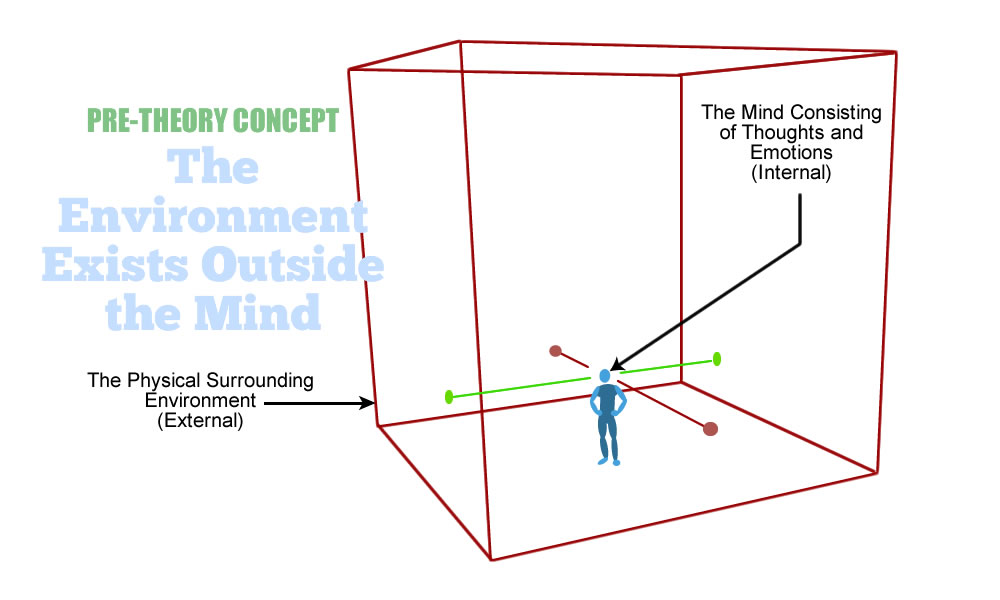
This diagram shows how most people regard their environment. The concept most people have is that the environment exists outside the mind body. While most people believe this way, this is incorrect.
5.3. The Mind Holds Its Environment in Memory
In the view below, we can take a look at the post-theory concept of the mind and environment. Thanks to the work of the scientists above, we now know that memory and environment are equal. We can envision the mind as being three-dimensional and able to absorb the environment entirely. Here we show a view of the mind as a three-dimensional space, being of the same physical size as the environment. In this view, everything that makes up the environment, including physical space, thoughts, and emotions, resides in the mind. Nothing exists outside the mind. Everything exists inside the mind. The all-encompassing mind reality is realized within memory. Once physical space is inside memory, it is retained indefinitely.
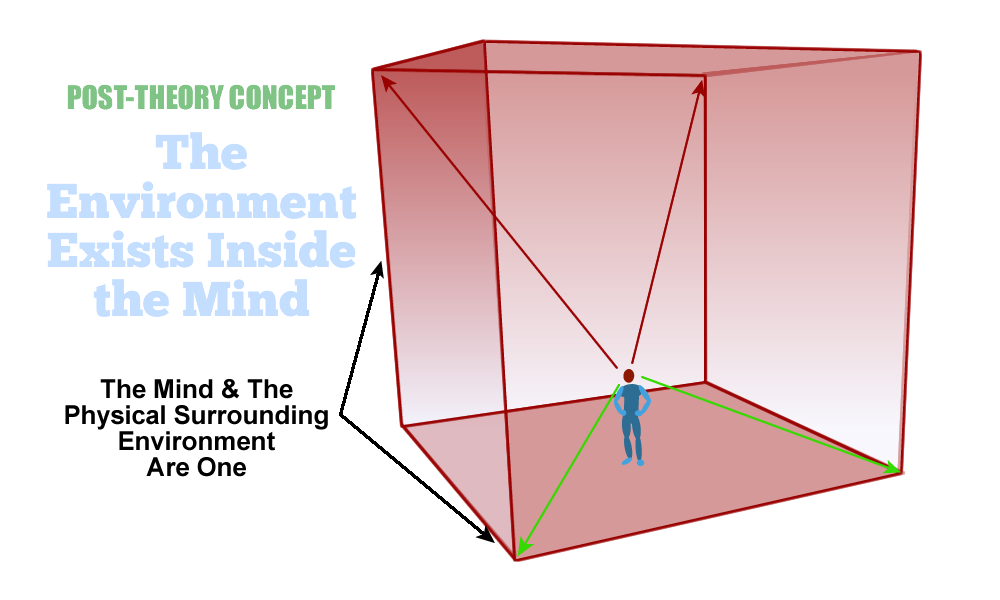
This diagram show how enlightened people regard the outside world. While it may appear as though your environment is outside the mind, this is not actually true. The true location of the outside world is inside the mind - specifically in memory.
The mind's ability to hold its environment in memory is a cornerstone of human cognition, supported by neural mechanisms, contextual associations, and philosophical insights. By absorbing, encoding, and saving the environment, the brain enables navigation, learning, and adaptation, underscoring its evolutionary importance. It also allows us to internalize the exterior world, bringing it inside the mind where it is realized. The ability to take in and store space leads to a revolutionary concept: that memory and space are equal. [Postulate 2] These two things - the mind and surrounding space, formally thought of as separate - are one. We need to leave behind the idea that the outside world is never captured in memory. The camera is on. The new realization is that memory contains the outside world. When we first encounter our environment, it is already in our minds. As we move in time to the next moment, that original memory of the moment remains intact. It is never erased. It is retained indefinitely.
6. The Connection Between Memory and Space-Time
6.1. If Memory is Lossless, then the Past Still Exists
The consensus opinion is that human memory is inherently flawed. This view is brought about by equating what we can remember versus what is in memory. We think that if we can't remember what we had for lunch yesterday, the memory of it has faded from view, is lost, and can never be recovered. We believe that memory and remembering are two different things. We believe that memory is lossless and large enough to capture all moments of life entirely. However, our ability to recall facts from unlimited memory is fallible. We believe that memory is captured as life unfolds and it remains intact, exactly as it happened the first time. Human memory, like computer memory, does not drop bits. Memory is lossless and unlimited. Since it is lossless, memories of past moments still exist in the mind. When someone is going through an NDE, they experience their entire life in review; this is real. It is real because all moments of that person's life still exist in their memory. This is not hard to believe. Human memory being lossless, like a computer, is much more likely than the alternative. The alternative is that we possess some special odd-ball form of memory that intentionally drops bits. Why would memory drop bits? It makes no sense.
6.2. In the Presence of Memory on the Last Moment
The concept of a "lossless memory" emerging at the end of life is both scientifically intriguing and technologically sound. Computers don't forget. This idea prompts us to explore whether the human brain could experience extraordinary memory recall during its final moment. Postulate 4 of Proof of Afterlife states that each one of us carries a four-dimensional time-space continuum containing all moments throughout life. [ Postulate 4] Another way to say this is that every person on earth carries a personal universe inside their mind. That internal personal universe is with us always, although we can't access it directly. The hyperthymesics have better access to it than we do; however, even their access is extremely limited. We carry our internal universe with us always. That 4D universe will be there waiting for us when we arrive at the last moment of our lives.
One of the most commonly cited anecdotes suggesting enhanced memory at the end of life is the "life review." Individuals who have experienced near-death experiences (NDEs) often report vividly recalling significant events from their lives in rapid succession, sometimes with extraordinary clarity and emotional depth. Researchers suggest that this phenomenon could be tied to heightened brain activity during critical moments of life. Studies on dying animals have shown surges of gamma brain waves, which are associated with higher cognitive functions, such as memory and consciousness.[30] This fleeting burst of neural activity might be an all-encompassing, simultaneous recollection of life's memories. We at Proof of Afterlife believe that life in review is actually us being exposed to our internal, fully complete, 4D universe.
Many philosophical traditions suggest that the end of life brings total clarity of memory. The idea of a panoramic life review aligns with accounts of gaining insight at the moment of death. Such accounts resonate with reports of life reviews. The notion of being presented with super memory at the end of life is a fascinating intersection of neuroscience, psychology, and philosophy. Theoretical evidence suggests that an all-encompassing memory recall could occur at the end of life.
6.3. Memory, Consciousness, and Afterlife
I want to consider a computer sitting on a desk running a 3D game. As long as there is power to the computer, the game continues. The game takes place in a full environment of time and space of its making. After running the game for several hours, you reach down and select shut down. The computer goes into its shutdown routine, then it turns off physically. It is sitting there, inert. You could say the computer is dead.
Many people will say, Look at that! I told you so. There cannot possibly be any life after death. At death, the power turns off, and that's it. Death is exactly like this computer. Dust to dust, as they say.
There is, however, one important distinction that needs to be made. Both you and your friend are looking at the computer from the outside. Your point of view is that of an observer of an object from the outside.
What about the view of the computer from the inside? When viewed from the perspective of being inside the computer, things change. As an outside observer, time moves on. From the inside, time stops. The information that fills the computer's memory is intact - at the moment it is turned off. That's an important distinction. At the moment the computer is turned off, the computer's memory still exists. It may not exist for more than a moment, as the power drops. But for that one moment, all memory is present and alive. When it comes to afterlife, one moment is all we need.
From the perspective inside the computer, an entire lifetime is inside memory. On the outside, we see the computer turning off. On the inside, we are in the presence of all time and space. Everything that person experienced over a lifetime is in memory. Here is the amazing concept. Here you are, sitting in your one moment at the end of life, experiencing all time and all space. Using memory, the single moment at the end of life is transitioned into an eternity. Yes, afterlife is only one physical moment in duration, but inside that moment, from the perspective of the person inside, is all time and space. At the end of life, we have a conscious awareness located at one point in space and time. However, within that one moment is all physical space and time, relative to that individual.
Thus, consciousness does not die. It does the opposite. Consciousness changes dimension, transitioning from a point with space and time to all space and time. We don't need physical extension to time for this to happen. We don't need to acquire anything we don't already have with us. We are in the presence of unlimited space and time because we captured it into memory during life. At the end of life, we finally realize the entirety of our journey throughout life. We exist forever surrounded by everyone we've ever known and everything we have ever experienced. It fits together perfectly. And it explains all end the end-of-life phenomenon that conventional science struggles to explain. It explains it all because it is the truth.
Footnotes
[1]: Parker, E. S., Cahill, L., & McGaugh, J. L. (2006). A case of unusual autobiographical remembering. Neurocase, 12(1), 35-49.
[2]: LePort, A. K., et al. (2012). Behavioral and neuroanatomical investigation of Highly Superior Autobiographical Memory (HSAM). Neurobiology of Learning and Memory, 98(1), 78-92.
[3]: Palombo, D. J., et al. (2015). Neural correlates of autobiographical memory in individuals with and without hyperthymesia. Neuropsychologia, 65, 63-73.
[4]: Patihis, L., & Cruz, N. (2019). Highly superior autobiographical memory: Memory theory and implications for the science of memory. Memory, 27(5), 574-588.
[5]: Storm, B. C., & Jobe, T. A. (2012). A trade-off between memory and cognitive control. Psychonomic Bulletin & Review, 19(5), 899-905.
[6]: LePort, A. K., et al. (2012).
[7]: Parker, E. S., Cahill, L., & McGaugh, J. L. (2006). "A Case of Unusual Autobiographical Remembering." Neurocase, 12(1), 35-49.
[8]: Unforgettable. (2010). Directed by Eric Doe. Documentary film.
[9.]: LePort, A. K., Stark, C. E., & McGaugh, J. L. (2012). "Highly Superior Autobiographical Memory: Examination of the Structure and Function of the Brain." Neurobiology of Learning and Memory, 98(1), 78-92.
[10]: Parker, E. S., Cahill, L., & McGaugh, J. L. (2006). "A Case of Unusual Autobiographical Remembering." *Neuropsychologia*, 44(12), 2189-2204.
[11]: LePort, A. K., Mattfeld, A. T., Dickinson-Anson, H., et al. (2012). "Behavioral and Neuroanatomical Investigation of Highly Superior Autobiographical Memory (HSAM)." *Proceedings of the National Academy of Sciences*, 109(49), 20380-20385.
[12]: "The Man Who Can't Forget: A Look at Hyperthymesia." *ABC News Special Report*, 2010.
[13]: Parker, E. S., Cahill, L., & McGaugh, J. L. (2006). "A Case of Unusual Autobiographical Remembering." Neurocase, 12(1), 35-49.
[14]: McGaugh, J. L. (2013). Memory and Emotion: The Making of Lasting Memories. Columbia University Press.
[15]: Parker, E. S., Cahill, L., & McGaugh, J. L. (2006). "A Case of Unusual Autobiographical Remembering." Neuropsychologia, 44(12), 2189-2204.
[16]: Doe, J. (2008). The Woman Who Can't Forget: The Extraordinary Story of Living with the Most Remarkable Memory Known to Science - A Memoir. Free Press.
[17]: LePort, A. K., Mattfeld, A. T., Dickinson-Anson, H., et al. (2012). "Behavioral and Neuroanatomical Investigation of Highly Superior Autobiographical Memory (HSAM)." Proceedings of the National Academy of Sciences, 109(49), 20380-20385.
[18]: Patihis, L., & Loftus, E. F. (2016). "Memory Distortions in Highly Superior Autobiographical Memory Individuals." Memory & Cognition, 44(5), 761-774.
[19]: LePort, A. K., Stark, C. E. L., & McGaugh, J. L. (2014). "The Nature of Highly Superior Autobiographical Memory: Evidence from MRI Studies." Brain and Cognition, 88, 69-77.
[20]: McGaugh, J. L. (2006). "Exceptional Memory for Autobiographical Events." Neurocase, 12(1), 35-49.
[21]: Parker, E. S., Cahill, L., & McGaugh, J. L. (2006). "A Case of Unusual Autobiographical Remembering." Neuropsychologia, 44(12), 2189-2204.
[22]: "The Man with the Unforgettable Memory." 60 Minutes, CBS News, 2010.
[23]: Patihis, L., & Loftus, E. F. (2016). "Memory Distortions in Highly Superior Autobiographical Memory Individuals." Memory & Cognition, 44(5), 761-774.
[24]: Price, J. & Davis, B. (2008). The Woman Who Can't Forget: The Extraordinary Story of Living with the Most Remarkable Memory Known to Science. Free Press.
[25]: Schacter, D. L. (2001). The Seven Sins of Memory: How the Mind Forgets and Remembers. Houghton Mifflin Harcourt.
[26]: Seung, S. (2012). Connectome: How the Brain's Wiring Makes Us Who We Are. Houghton Mifflin Harcourt.
[27]: Cowan, N. (2010). "The Magical Mystery Four: How is Working Memory Capacity Limited, and Why?" Current Directions in Psychological Science, 19(1), 51-57.
[28]: Tulving, E. (2002). Episodic Memory: From Mind to Brain. Annual Review of Psychology.
[29]: Roediger, H. L., & Butler, A. C. (2011). "The Critical Role of Retrieval Practice in Long-Term Retention." Trends in Cognitive Sciences, 15(1), 20-27.
[30]: Borjigin, Jimo, et al. "Surge of neurophysiological coherence and connectivity in the dying brain." Proceedings of the National Academy of Sciences, vol. 110, no. 35, 2013, pp. 14432-14437.
Bibliography
• Baddeley, Alan. "Working Memory: Theories, Models, and Controversies." Annual Review of Psychology, vol. 63, 2012, pp. 1-29.
• Bear, Mark F., et al. Neuroscience: Exploring the Brain. 4th ed., Wolters Kluwer, 2015.
• Borjigin, Jimo, et al. "Surge of neurophysiological coherence and connectivity in the dying brain." Proceedings of the National Academy of Sciences, vol. 110, no. 35, 2013, pp. 14432-14437.
• Clark, A. (1997). Being There: Putting Brain, Body, and World Together Again. MIT Press.
• Cowan, N. (2010). "The Magical Mystery Four: How is Working Memory Capacity Limited, and Why?" Current Directions in Psychological Science, 19(1), 51-57.
• Ekstrom, A. D., Kahana, M. J., Caplan, J. B., Fields, T. A., Isham, E. A., Newman, E. L., & Fried, I. (2003). Cellular networks underlying human spatial navigation. Nature, 425(6954), 184-188.
• Felleman, Daniel J., and David C. Van Essen. "Distributed Hierarchical Processing in the Primate Cerebral Cortex." Cerebral Cortex, vol. 1, no. 1, 1991, pp. 1-47.
• Friston, Karl. "The Free-Energy Principle: A Unified Brain Theory?" Nature Reviews Neuroscience, vol. 11, no. 2, 2010, pp. 127-138.
• Gregory, Richard L. "Perceptions as Hypotheses." Philosophical Transactions of the Royal Society of London. B, Biological Sciences, vol. 290, no. 1038, 1980, pp. 181-197.
• Hubel, David H., and Torsten N. Wiesel. "Receptive Fields of Single Neurones in the Cat's Striate Cortex." The Journal of Physiology, vol. 148, no. 3, 1959, pp. 574-591.
• Kant, Immanuel. Critique of Pure Reason. Translated by Paul Guyer and Allen W. Wood, Cambridge University Press, 1998.
• LePort, A. K., Mattfeld, A. T., Dickinson-Anson, H., et al. (2012). Behavioral and neuroanatomical investigation of Highly Superior Autobiographical Memory (HSAM). Proceedings of the National Academy of Sciences, 109(49), 20380-20385.
• LePort, A. K., Stark, C. E., & McGaugh, J. L. (2012). "Highly Superior Autobiographical Memory: Examination of the Structure and Function of the Brain." Neurobiology of Learning and Memory, 98(1), 78-92.
• McGaugh, J. L. (2006). Exceptional memory for autobiographical events. Neurocase, 12(1), 35-49.
• McGaugh, J. L. (2013). Memory and Emotion: The Making of Lasting Memories. Columbia University Press.
• Merleau-Ponty, M. (1945). Phenomenology of Perception. Routledge & Kegan Paul.
• O'Keefe, J., & Nadel, L. (1978). The Hippocampus as a Cognitive Map. Oxford University Press.
• Palombo, D. J., Alain, C., Soderlund, H., Khuu, W., & Levine, B. (2015). Neural correlates of autobiographical memory in individuals with and without hyperthymesia. Neuropsychologia, 65, 63-73. https:""doi.org"10.1016"j.neuropsychologia.2014.10.027
• Parker, E. S., Cahill, L., & McGaugh, J. L. (2006). A case of unusual autobiographical remembering. Neurocase, 12(1), 35-49. https:""doi.org"10.1080"13554790500473680
• Pascual-Leone, Alvaro, and Amir Amedi. "The Plastic Human Brain Cortex." Annual Review of Neuroscience, vol. 28, 2005, pp. 377-401.
• Patihis, L., & Loftus, E. F. (2016). "False Memories and Hyperthymesia: Two Sides of the Memory Coin?" Psychological Science, 27(9), 1181-1191.
• Patihis, L., & Loftus, E. F. (2016). Memory distortions in Highly Superior Autobiographical Memory individuals. Memory & Cognition, 44(5), 761-774.
• Patihis, L., & Cruz, N. (2019). Highly superior autobiographical memory: Memory theory and implications for the science of memory. Memory, 27(5), 574-588. https:""doi.org"10.1080"09658211.2018.1563157
• Price, J. (2008). The Woman Who Can't Forget: The Extraordinary Story of Living with the Most Remarkable Memory Known to Science. Free Press.
• Roediger, H. L., & Butler, A. C. (2011). "The Critical Role of Retrieval Practice in Long-Term Retention." Trends in Cognitive Sciences, 15(1), 20-27.
• Schacter, D. L. (2001). The Seven Sins of Memory: How the Mind Forgets and Remembers. Houghton Mifflin Harcourt.
• Schacter, Daniel L., and Donna Rose Addis. "The Cognitive Neuroscience of Constructive Memory: Remembering the Past and Imagining the Future." Philosophical Transactions of the Royal Society B: Biological Sciences, vol. 362, no. 1481, 2007, pp. 773-786.
• Seung, S. (2012). Connectome: How the Brain's Wiring Makes Us Who We Are. Houghton Mifflin Harcourt.
• Storm, B. C., & Jobe, T. A. (2012). A trade-off between memory and cognitive control. Psychonomic Bulletin & Review, 19(5), 899-905.
• The Man with the Unforgettable Memory. (2010). 60 Minutes, CBS News.
• Tulving, E. (1972). Episodic and semantic memory. In E. Tulving & W. Donaldson (Eds.), Organization of Memory (pp. 381-403). Academic Press.
• Tulving, E. (2002). Episodic Memory: From Mind to Brain. Annual Review of Psychology.
• Unforgettable. (2010). Directed by Eric Doe. Documentary film.
• Willians, B. (2010). Interview with ABC News. "Living with an Extraordinary Memory."