Can Memory Store Time?
A Mathematical Framework for Time Beyond the Body
The question of eternal life is usually framed in terms of survival. If a human being dies, how could that person continue to exist indefinitely? The obvious answer seems to require that the physical body, or some physical replacement for it, continue to function indefinitely.
That immediately creates an enormous physical problem. An organism must consume energy, maintain its structure, resist entropy, and continue through every successive moment of time. If eternal life means that a physical body must survive forever, the requirements appear almost impossibly demanding.
But there is another way to approach the problem.
Instead of asking how a physical body can survive through eternity, ask whether an existence that unfolds through time must itself remain physically present throughout the time it represents.
The distinction is subtle, but it changes the problem completely.
The 4D Model
Consider a conventional three-dimensional environment, developed in 3D software like Blender, that contains a object: a box, a building, or a human body.
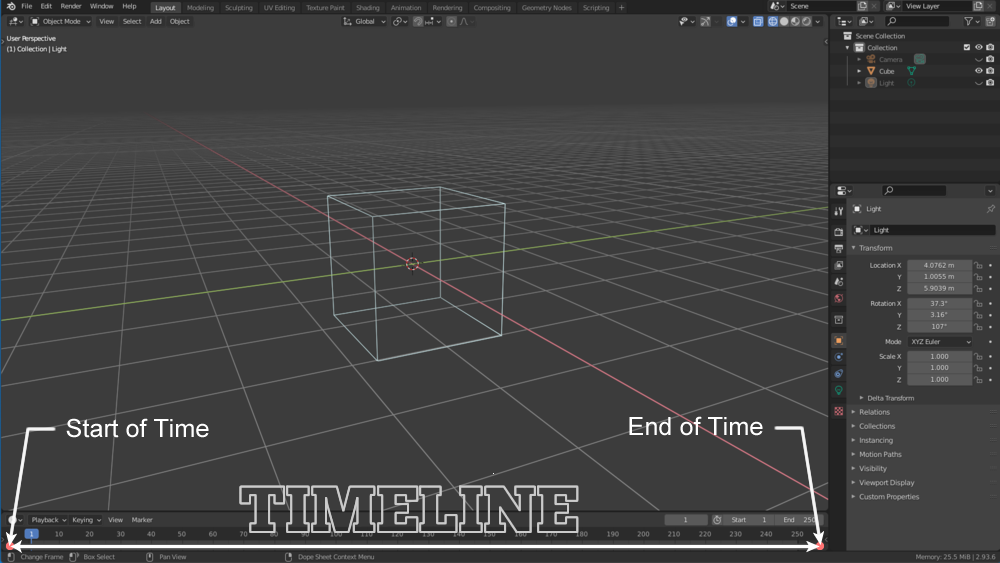
Now imagine adding time as a fourth dimension, as shown by the time line control panel shown at the bottom of the screen. The result is a four-dimensional representation of the object, not merely as it exists at one instant, but as it exists throughout a period of time represented by the span of the timeline, from left to right.
In a 4D model, the temporal dimension can be represented as part of the model itself. An object can therefore be represented not only by its position and shape in three-dimensional space, but by its condition at different points along a temporal dimension.
Imagine, for example, a model of a human life.
At one location along the model's time dimension is the person as a child. Farther along the temporal dimension is the person as an adult. Farther still is the person at an advanced age.
The life model, like the Blender 3D model above, contains that person's entire temporal existence.
The critical observation is this: in 3d modeling, the time line is present within the model. Yet the entire model exists in memory on the hard disk. in this way, time is contained within memory on the hard disk. That is why a physical body is not required for eternal life.
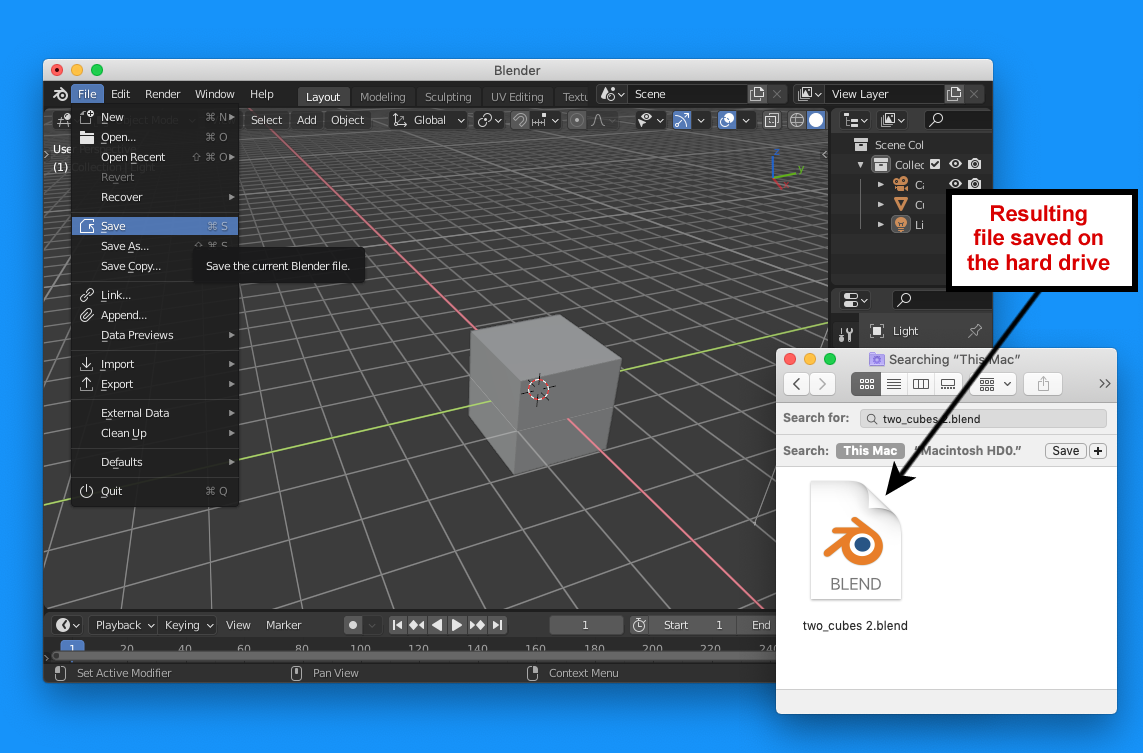
Here we are, in the act of saving the enitre model, time and all, to the disk by selecting File, Save. This disk file can be static. It need not change, move, or evolve to fully render time within the model. Therefore, the disk file only needs to exist for a moment. That distinction is the foundation of the argument.
Two Different Times
There are, conceptually, two different temporal systems involved.
Time of the Physical Medium
The first is the time experienced by the physical storage medium. A hard drive, memory chip, or other physical device exists at a particular physical moment. Its physical state can change as the computer operates.
Time Represented Within the Model
The second is the time represented inside the model. The model may contain an entire sequence of events extending from an earlier time to a later time. Those events are represented as relationships within the information structure.
These two times are not required to be identical.
They are not required to advance at the same rate.
Most importantly, they do not have to traverse their respective timelines simultaneously.
The Hard Drive Can Stop
Consider the simplest possible example.
A computer contains a complete 4D model of a person's life.
At 12:00:00, the model exists on the hard drive.
At that instant, the hard drive can be physically stopped. Nothing requires the hard drive itself to continue operating in time for the information containing those eighty years to exist within the model.
The physical storage medium has stopped advancing through its own time.
Yet the temporal dimension inside model remains complete.
This does not mean that the hard drive has physically experienced eighty years in an instant. It has not. It means something different: The duration inside the model can be different from the duration of the physical medium on the hard drive.
The two timelines are not colinear. The time associated with the storage medium and the time represented within the model can be conceptually independent.
Representation Is Not the Same as Traversal
This distinction becomes clearer when we separate two ideas that are normally treated as though they were the same.
Traversing Time
Traversing time means experiencing one moment after another. A biological human being traverses time. At one moment the person is in one physical location with respect to time; at the next moment the person is in another.
Representing Time
Representing time means containing information about moments and their relationships. A temporal model can represent an entire sequence without requiring the physical storage medium to experience that sequence in the same manner.
The file on the disk does not have to live through the eighty years in order to manifest eighty years. A Blender 4D model has time line controls allowing the user to experience the entire 80 years without ever having to change the underlying model that created it. Movement of the disk file through time is not needed to experience the entire duration of time within the model.
This is the central distinction upon which the theory of eternal existence rests.
A Moment Can Contain a Timeline
Now consider what happens when the physical file itself is confined to a single moment.
At that one physical instant, the information within the file contains the contents of an entire temporal existence.
The physical storage medium occupies one moment of its own time. The model contains many moments of its represented time.
Thus: One physical moment can contain an entire temporal sequence.
This does not mean that the physical storage medium has somehow experienced the entire sequence. It has not. The temporal sequence within the model has arisen from the infromaton contained within the physical file on the medium.
The timeline inside the model is therefore not the same thing as the timeline of the hard drive.
The hard drive's time can stop while the model's timeline remains fully alive.
From Memory to Eternity
This provides a possible answer to a problem that otherwise seems nearly impossible.
If eternal life requires a physical human body to remain alive for an infinite duration, then eternal life appears to require the indefinite continuation of the body's physical processes.
But suppose consciousness does not ultimately require the continued existence of the original biological body. Suppose instead that memory can exist as an informational structure, likened to the model on the hard drive. The model itself is holding the entire temporal identity of the individual.
Then the requirement changes.
The physical substrate no longer has to survive for the entire duration of the person's existence to be represented witin the model. Memory only has to hold the information that constitutes that existence for one moment in time. The body experiences time. The information structure in memory contains time.
Once that distinction is made, eternal existence no longer necessarily requires an eternally functioning body.
The Dimensional Transformation
This is where the concept can be understood as a change in dimensional state.
A person normally experiences existence as a succession of moments. There is a present moment, followed by another moment, followed by another. Time is something through which the person moves.
But when the temporal existence is represented as part of a higher-dimensional information structure, made possible by absorbing these moments into memory as you move through them, the relationship changes.
Time becomes something that is contained within the memory structure.
The individual existence has not necessarily become longer in the ordinary sense. Rather, its temporal dimension accumulates within the model on the hard drive. Thus time has become represented within another physical dimension of information.
The important distinction is between living through time and having one's existence represented throughout time.
Eternal Life Without an Eternal Body
This leads to a radically different conception of eternal life.
Eternal life does not necessarily mean that a biological body continues functioning forever.
It could instead mean that a complete conscious existence is contained within a memory informational structure whose own temporal existence is not required to traverse the represented existence moment by moment.
Under this conception, the physical body is a mechanism for producing and experiencing a temporal existence. It need not necessarily be the permanent container of that existence.
The body may be temporary. The information constituting the person may be preserved. And the temporal existence of the person may be represented independently of the temporal persistence of the original body.
This is why the question of eternity becomes a question of representation rather than survival.
The Hard Drive Does Not Have to Continue Living
It is important not to misunderstand the analogy.
The hard drive does not become the person. The hard drive does not experience the person's life. And the hard drive does not somehow experience eighty years in zero seconds.
Instead, the hard drive provides physical memory capable of representing information whose internal structure includes a temporal dimension.
The distinction is between the time experienced by the represented consciousness and the time experienced by the physical substrate containing the representation.
There is no requirement that those two durations be identical.
Eternity as a Complete Temporal Structure
The final implication is perhaps the most difficult to comprehend.
We normally imagine eternity as an infinitely long sequence: Moment → moment → moment → moment → forever.
Under that conception, an individual would have to continue moving along the line forever.
But the information model suggests another possibility.
Instead of thinking of eternity as an infinitely long sequence that must be physically traversed, imagine eternity as a temporal structure that is contained.
The distinction is between living through time and having one's existence represented across time.
If the latter is physically possible, then the requirement for an eternally functioning biological body disappears.
The body would not have to survive forever. The physical substrate would not have to experience every moment represented by the model. The substrate and the represented timeline could occupy fundamentally different temporal relationships.
From One Moment to Eternity
This leads to the central proposition of the theory: A moment can become an eternity when the temporal existence associated with that moment becomes contained as information rather than requiring continuous physical traversal.
The word "become" is important.
The argument is not that a moment is secretly infinite. A moment remains a moment in the time of the physical substrate.
What changes is the dimensional representation of the existence contained within that moment.
The substrate occupies one point in its own timeline. The information contained by that substrate can represent an existence extending across another timeline.
Thus a finite physical state can correspond to a temporal structure vastly larger than the duration of that physical state.
And if the temporal structure has no terminal point, the representation need not be limited to a finite lifetime.
The Final Question
This does not by itself prove that human consciousness can be converted into such a structure. That is a separate question, and it is one of the most important questions in the overall theory.
The argument here is narrower. It addresses the objection: Even if consciousness could somehow be preserved, how could it possibly exist forever?
The answer proposed by this theory is that forever does not necessarily require the physical substrate (disk image) to survive through forever.
The substrate and the represented existence need not share the same timeline.
The disk image can exists for just one a moment. The model (disk image) can contain a lifetime. And if the model can contain a temporal existence without requiring the disk image to traverse time, then the physical impossibility commonly associated with "living forever" may no longer apply.
The problem of eternity therefore becomes a problem of dimensional representation.
The Final Proposition
The body exists in time.
Its memory contains time.
When each moment can be contained while it is traversed, eternity no longer has to mean an endlessly surviving physical body. It can mean the complete existence of a temporal structure within the finite disk file within physical memory.
A moment remains a moment for the disk file, while containing an existence that extends across an entire timeline.
The physical disk file and its represented existence do not have to move through time together.
The question is no longer, "How can a body live forever?"
The question becomes, "Can a finite physical memory file contain a complete temporal existence?"
If the answer is yes, then the possibility of eternal life takes on an entirely new meaning.
NDE Provides Life-In-Review Evidence
A prospective ICU study provides an especially interesting observation. Researchers studying survivors of prolonged intensive-care treatment found that altered time perception and life review were among the most frequently reported features of the near-death experiences they documented. The life review involved the emergence or re-experiencing of memories from the individual's past, while altered time perception included experiences in which the normal passage of time was profoundly changed. [1]
The significance is striking. A lifetime consists of events distributed across years or decades, yet those events can apparently be brought together within a single conscious experience. The physical events occurred sequentially, but their informational representation did not have to be experienced sequentially. The life review therefore provides a natural example of the distinction proposed by this theory: a temporal existence can be contained as information within memory without the containing memory having to traverse the entire duration of that existence.
This is precisely the distinction between the information in memory and the existence represented by that information. A physical state may occupy only a moment, while the information contained within that moment can represent an existence extending across an entire lifetime. The NDE life review offers an observed phenomenon that makes this otherwise difficult concept much easier to visualize. [1]
Footnote
[1] Charlotte Martial et al., "Phenomenological memory characteristics and impact of near-death experience in critically ill survivors: Observations at discharge and after a 1-year follow-up," International Journal of Clinical and Health Psychology 24, no. 3 (2024): 100478. The prospective study included 126 ICU survivors, with 19 reporting a near-death experience meeting the study threshold. Altered time perception and life review were among the most frequently reported near-death experience features. Full study .