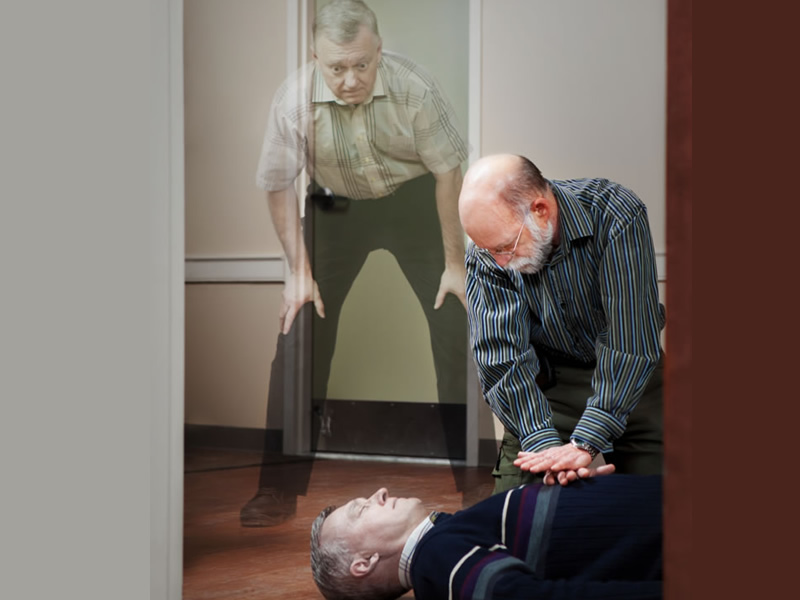
Case One: Out Of Body Experience
Evidence Abstract
Out-of-Body Experiences (OBEs) offer a remarkable insight into the dimensional nature of human consciousness, revealing that awareness is not confined to the physical body. During an OBE, a person's conscious point of view temporarily shifts from a zero-dimensional (0D) state inside the brain to a fully three-dimensional (3D) spatial state, allowing perception of the environment from outside the body. Thousands of consistent accounts describe observing one's own body from above, heightened sensory perception, and profound detachment from physical limitations. Within the framework of Afterlife Theory, OBEs are not hallucinations but genuine dimensional transformations of consciousness, providing empirical evidence that awareness can expand beyond the body, especially in life-threatening or near-death situations. These experiences illuminate the geometric and memory-based structure of the mind, offering a new perspective on consciousness, memory, and the afterlife.
1. Out of Body Experience - Consciousness Study
Out-of-Body Experiences (OBEs) provide a unique window into the dimensional nature of human consciousness. During an OBE, a person's point of view or conscious awareness temporarily shifts from its ordinary zero-dimensional (0D) state - anchored within the physical body - to a fully three-dimensional (3D) spatial state, allowing perception of the surrounding environment from outside the body. This transition is not merely a perceptual illusion or hallucination; it reflects a genuine expansion of awareness in which consciousness occupies the space around the body. Thousands of accounts report remarkably consistent experiences, including viewing one's own body from above, observing events beyond normal sensory reach, and experiencing a profound detachment from physical limitations. Within the framework of Proof of Afterlife Theory, OBEs demonstrate that consciousness can temporarily transcend its embodied point-of-view, providing empirical support for the hypothesis that awareness is capable of dimensional transformation at the threshold of life-threatening events.
2. OBE As Evidence of (3D) Consciousness
Out-of-Body Experiences (OBEs) provide compelling evidence that human consciousness is capable of dimensional transformation, rather than mere spatial displacement. During an OBE, consciousness does not simply move from a location inside the body to a location outside it; instead, it transitions from a zero-dimensional (0D) point-like state to a three-dimensional (3D) space-like state. This dimensional expansion allows consciousness to process overwhelming sensory input and maintain mental equilibrium during severe trauma, such as a stroke or life-threatening event. Although the duration of an OBE is brief - typically lasting only seconds - it can feel significantly longer due to the altered perception of time, and its impact is profound. Cross-cultural accounts, scientific studies, and verifiable testimonies consistently describe OBEs with striking similarity, indicating that they are not hallucinations but manifestations of consciousness expanding into space. Interpreting OBEs as a change of dimension, rather than mere movement, reframes these experiences as critical evidence for the broader geometric model of consciousness proposed in Afterlife Theory.
3. Out of Body Experience - Interpreted by Medicine
Out-of-Body Experiences (OBEs) challenge conventional medical explanations by demonstrating that consciousness can operate independently of the physical body. While the medical community often interprets OBEs as hallucinations arising from neurological, psychological, or environmental factors, the Proof of Afterlife model interprets them as a genuine dimensional transformation of consciousness. During an OBE, awareness shifts from a zero-dimensional (0D) point-like state to a three-dimensional (3D) space-like state, allowing the mind to perceive the surrounding environment from a perspective untethered to the body. This dimensional expansion accounts for hallmark features of OBEs, including the sense of separation from the body, heightened sensory perception, fluid spatial orientation, and, in some cases, the verifiable observation of external events. True OBEs are rare, occurring predominantly in extreme trauma or near-death situations, yet their consistent phenomenology across cultures and historical periods supports the reality of consciousness operating beyond physical constraints. Interpreting OBEs as a spatial expansion of consciousness provides a coherent framework for understanding these experiences and offers insight into the dimensional nature of awareness as it approaches the end of life.
4. Three Accounts of Out Of Body Experiences
The detailed accounts of OBEs from Al Doe, Pam Doe, and Dr. Ralph Doe provide compelling evidence of consciousness extending beyond the physical body. Al Doe's observation of specific surgical details, including a hidden sticker, Pam Doe's vivid descriptions during a state of clinical near-death, and Dr. Ralph Doe's accurate recounting of events inside and outside a resuscitation room challenge conventional neurological models. These experiences share common elements, including detachment from the body, heightened awareness, and verified observations, suggesting a phenomenon that transcends traditional explanations of hallucinations or neural activity. While neurological theories, such as disruptions in the temporoparietal junction, offer partial insights, the verifiability of these accounts underscores the need for a broader paradigm, such as the memory/awareness model. This model posits that memory exists as surrounding space, allowing consciousness to move independently within it, potentially offering a scientific framework for understanding OBEs. These cases collectively suggest that OBEs are not mere illusions but a profound reality, challenging the boundaries of consciousness studies and human perception.
5. Out of Body Experience: Why It Enlightens
Out-of-Body Experiences (OBEs) provide profound insight into the dimensional nature of human consciousness, often leaving those who experience them with a sense of enlightenment. During an OBE, consciousness shifts from its ordinary zero-dimensional (0D) point within the brain to a fully three-dimensional (3D) space-like state, allowing the individual to perceive their environment from an entirely new vantage point - typically floating above the body and observing it from the ceiling. This sudden displacement reveals that the mind itself is spatial, and that memory constitutes the surrounding space in which consciousness operates. By witnessing the environment in this way, individuals realize that all perception is contained within memory, and that consciousness is not bound to the physical body. OBEs are rare, occurring primarily during extreme trauma or near-death events, yet they leave lasting impressions by demonstrating firsthand that awareness can expand beyond its usual confines. This dimensional shift not only validates the reality of consciousness outside the body but also provides direct experiential evidence of the spatial, memory-based structure of the mind, offering a transformative perspective on life, consciousness, and the afterlife.
6. How Afterlife Theory OBE Definition Stands Apart
Afterlife Theory provides a unique and rigorously defined framework for understanding Out-of-Body Experiences (OBEs) as a geometric, dimensional transition of consciousness rather than a metaphorical or mystical phenomenon. In this model, consciousness exists initially as a zero-dimensional (0D) point - the self - anchored within the body. During an OBE, this point undergoes a dimensional shift, detaching from the body and expanding into three-dimensional (3D) space, enabling awareness to operate independently of the physical form. Unlike other OBE interpretations, which often describe these experiences as excursions to "other planes" without formal structure, Afterlife Theory ties the dimensional change directly to memory, awareness, and spatial perception. This dimensional approach extends naturally to Near-Death Experiences (NDEs), wherein consciousness progresses into a four-dimensional (4D) space-time continuum, integrating memory and temporal relationships. By unifying geometry, consciousness, and memory into a single framework, Afterlife Theory uniquely explains OBEs as measurable, structural phenomena and provides predictive insight into the nature of post-mortem awareness and the afterlife.